The best coffee concentrate is the one that tastes like real brewed coffee in the drinks you actually make, with nothing added that you didn't ask for. Labels in India vary a lot, so here are the seven things worth checking before you buy.
1. What beans are in it
Look for the coffee type on the label. Arabica is smoother and sweeter, with more aroma. Robusta is stronger and more bitter, and cheaper to grow. Many blends mix the two without saying how much of each.
A label that says "100% Arabica" and names where the coffee comes from tells you more than one that just says "premium coffee". India grows excellent Arabica in Chikmagalur, Coorg and the Nilgiris.
2. Sugar and sweeteners
Some concentrates are pre-sweetened. That's fine if you always take sugar, but it limits you: you can't make a black coffee or control sweetness for the rest of the family. An unsweetened concentrate lets each person add their own sugar, jaggery or nothing at all.
3. Preservatives and additives
Read the ingredients list. The shortest list is usually the best one: coffee and water. For filter-style concentrates, chicory is a traditional ingredient, not an additive, as long as the label tells you how much.
4. Price per cup, not price per pack
Packs come in different sizes and need different amounts per cup, so compare the cost per cup:
Price per cup = pack price ÷ (pack size in ml ÷ ml used per cup)
For example, a 200 ml pouch used at 20 ml per cup makes 10 cups. If that pouch costs ₹400, each cup costs ₹40. A cheaper pack that needs 30 ml a cup can end up costing more per cup.
5. Shelf life and storage
Check how long it keeps unopened and what to do after opening. A long unopened shelf life (several months) means you can stock up. Most concentrates should go in the fridge once opened.
6. How it tastes in milk and over ice
In India, most coffee is drunk with milk: lattes, cold coffee and filter coffee. A good concentrate holds its flavour in 150–160 ml of milk without tasting watery or burnt. If you mostly drink cold coffee, check that it dissolves straight into cold milk with no stirring battle.
7. Is it made for the coffee you drink
There are two broad styles:
If you drink mostly... | Look for |
|---|---|
Lattes, iced lattes, Americanos, cold coffee | An Arabica concentrate, unsweetened |
South Indian filter coffee | A coffee-and-chicory concentrate (around 80:20 is traditional) |
Both | Two concentrates, or a starter pack with one of each |
A quick checklist
Check | What good looks like |
|---|---|
Beans | Named type (e.g. 100% Arabica) and origin |
Sugar | Unsweetened, so you control it |
Ingredients | Coffee and water (plus chicory for filter coffee) |
Price | Worked out per cup |
Shelf life | Several months unopened |
Taste in milk | Full flavour in 150–160 ml of milk |
Measuring | A spoon or pump, so every cup is the same |
How STIR measures up
We make STIR to tick every box above:
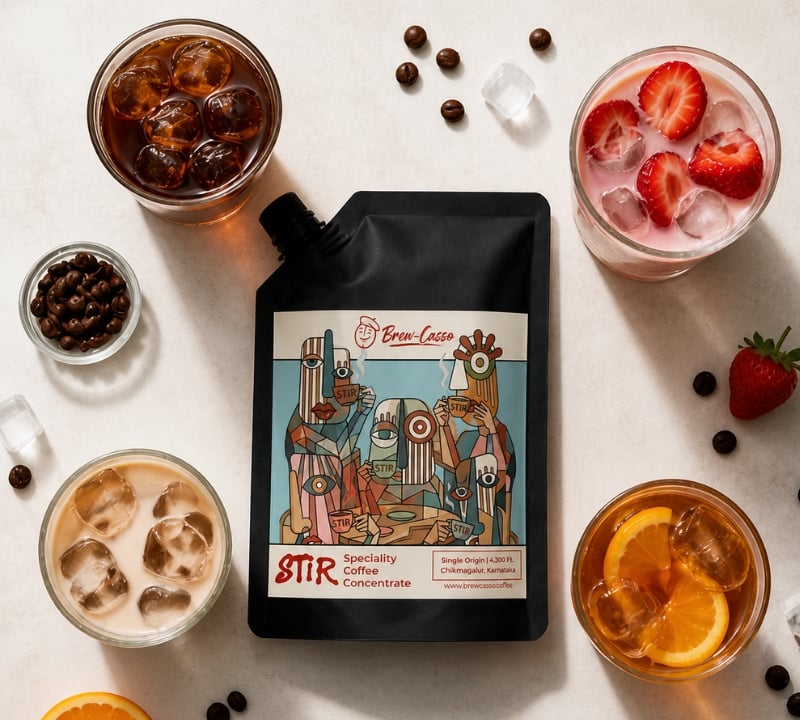
STIR Speciality is 100% Arabica from Chikmagalur, with no sugar and no preservatives. Use 20 ml in 150–160 ml of hot or cold milk.
STIR Filter is 80% coffee and 20% chicory, for South Indian filter coffee without the decoction.
Both keep 9 months unopened and come with a 10 ml measuring spoon.
Not sure which one? The Starter Bundle has one of each. Then try them in our cold coffee or iced filter coffee recipes.
FAQs
Is coffee concentrate the same as instant coffee? No. Instant coffee is brewed coffee that's been dried into powder or granules. A concentrate is liquid coffee, so there's nothing to dissolve. See instant coffee vs coffee concentrate.
How much concentrate do I use per cup? It depends on the brand. For STIR, 20 ml in 150–160 ml of milk or water.
Does coffee concentrate need to be refrigerated? Unopened, usually not. Check the label. Once opened, keep it in the fridge.
Can I use it for hot coffee? Yes. Pour it into hot milk or water. You don't need a machine.